Writing a professional, polished
business letter or business email is easy once you know the basics. Most
business letters are written in a simple format that is easily adapted to any
company’s needs, and business email follows a similarly simple format. Read on
to learn more about how to make your business correspondence look its best.
How to write
business letter : The basics
A business letter always contains a few standard parts:
·
The date
·
Information about its sender and recipient
·
A salutation
·
A body consisting of a few concise paragraphs
·
A closing
·
The sender’s signature
·
The sender’s typed name, title, and contact
information
·
A list of enclosures, if necessary
Company address:
If your company has letterhead, you can use this instead of typing out the
information. If not, your company’s address should appear either right or left
justified at the top of the page. Write out each word in the address instead of
using abbreviations. For example:
ABC, Inc.
400 Leafy Lane
Los Angeles, California 90002
400 Leafy Lane
Los Angeles, California 90002
Date:
Write the date out rather than abbreviating with numbers only. For example,
“March 1, 2015” or “1 March 2015.” The date should be left justified and should
be positioned two or three lines above the recipient’s address.
Recipient’s name and address:
Add the recipient’s name, their title if known, and their address. Write
out each word in the recipient’s address. This information should be left
justified a few lines above the salutation. For example:
Mr. Jack Reacher
Merchandising Manager
Craft Supply Provider, Inc.
602 Spinner’s Road
Los Angeles, California 90001
Merchandising Manager
Craft Supply Provider, Inc.
602 Spinner’s Road
Los Angeles, California 90001
Salutation:
Choose your salutation based on whether you know the person to whom you are
writing, how well you know them if so, and the relationship’s level of
formality. A salutation is more than a simple greeting; it is an indicator of
respect. There are several options to use depending on the situation:
·
To Whom It May Concern: Use this
generic greeting only if you don’t know whom you are specifically addressing.
·
Dear Sir / Madam: This is
another generic greeting that should only be used if you don’t know who will be
reading your letter.
·
Recipient’s Title and Last Name: This is
a widely accepted method of incorporating a salutation into business
correspondence. Examples include: “Dear Dr. Jamison” or “Dear Professor
Williams.” The salutations “Dear Mr. Smith,” “Dear Ms. Kennedy,” and “Dear Mrs.
Rollins” are additional examples of this kind of greeting.
·
Recipient’s First Name: Use this
only if you and the recipient already enjoy an informal relationship. An
example is: “Dear Maria.”
·
The Recipient’s Whole Name: If the
recipient does not have a title and you are unsure of their gender, you should
greet them using their entire name. For example: “Dear Pat Brown.”
Always add a comma after a salutation, unless you are using “To Whom It May
Concern,” in which case a colon is appropriate.
Body:
The body of your business letter should contain a few concise paragraphs
that convey your message clearly. Strike the right tone by avoiding lengthy,
meandering sentences and getting straight to the point. If you are not sure how
to start, consider using “I am writing you regarding…” as the opening phrase.
Your reader will get the best impression when your meaning is
crystal-clear. You should explain your position using as few words as possible
an. At the same time, feel free to be conversational if it is appropriate.
Business correspondence should be friendly and helpful if possible.
Summarize your points clearly in the last paragraph and outline your
expectations or your planned course of action. This is a suitable place to
mention that the recipient may contact you with concerns or questions. Be sure
to thank the recipient for his or her attention to the letter or to the matter
at hand.
Closing:
Like its salutation, a business letter’s closing is an indicator of respect
that should reflect the formality of your relationship.
·
Formal Closing: A
closing such as “Sincerely,” “Yours sincerely,” “Respectfully,” “Yours Truly,”
“Regards,” and “Cordially” are suitable for all types of business
correspondence.
·
Informal Closing: Less
formal closings such as “Best wishes,” “Warm regards,” “Best,” “Thank you,” and
“All the best” are still professional, but are best for letters to people with
whom you enjoy an ongoing, friendly business relationship.
Use a comma after your closing, no matter which you choose. Left justify
the closing.
Signature:
Leave about four lines of text empty so you have room to sign your name.
Use blue or black ink for a clean, professional look.
Sender’s typed name and contact
information:
Type your name, then add your title on the next line. Skip a line, then
type your telephone number. On the next line, type your email address. For
example:
Terry Brown
Vice President of ABC, Inc.
223-555-1212
t.brown@abc-inc.com
This information should be left justified.
Vice President of ABC, Inc.
223-555-1212
t.brown@abc-inc.com
This information should be left justified.
Enclosures (if applicable):
If you plan to enclose anything with your business letter, type the word
“Enclosures” followed by a colon and make a note that tells the recipient what
else to look for in the envelope. For example:
Enclosures (2): brochure, flyer
Enclosures: two brochures
Enclosures: two brochures
2. Part of Business Letter
The Heading (The Retern Address) or
Letterhead - Companies usually use printed paper where heading or
letterhead is specially designed at the top of the sheet. It bears all the
necessary information about the organisation’s identity.
Date - Date of writing. The month
should be fully spelled out and the year written with all four digits October
12, 2005
(12 October 2005 - UK style). The date is aligned with the return address. The number of the date is pronounced as an ordinal figure, though the endings st, nd, rd,th, are often omitted in writing. The article before the number of the day is pronounced but not written. In the body of the letter, however, the article is written when the name of the month is not mentioned with the day.
(12 October 2005 - UK style). The date is aligned with the return address. The number of the date is pronounced as an ordinal figure, though the endings st, nd, rd,th, are often omitted in writing. The article before the number of the day is pronounced but not written. In the body of the letter, however, the article is written when the name of the month is not mentioned with the day.
The Inside Address - In a
business or formal letter you should give the address of the recipient after
your own address. Include the recipient's name, company, address and postal
code. Add job title if appropriate. Separate the recipient's name and title
with a comma. Double check that you have the correct spelling of the recipient
's name.
The Inside Address is always on the left margin. If an 8 1/2" x 11" paper is folded in thirds to fit in a standard 9" business envelope, the inside address can appear through the window in the envelope.
The Inside Address is always on the left margin. If an 8 1/2" x 11" paper is folded in thirds to fit in a standard 9" business envelope, the inside address can appear through the window in the envelope.
The Greeting - Also called the
salutation. The type of salutation depends on your relationship with the
recipient. It normally begins with the word "Dear" and always
includes the person's last name. Use every resource possible to address
your letter to an actual person. If you do not know the name or the
sex of of your reciever address it to Dear Madam/Sir (or Dear Sales Manager or
Dear Human Resources Director). As a general rule the greeting in a
business letter ends in a colon (US style). It is also acceptable to use a
comma (UK style).
The Subject Line (optional) - Its
inclusion can help the recipient in dealing successfully with the aims of your
letter. Normally the subject sentence is preceded with the word Subject: or Re: Subject
line may be emphasized by underlining, using bold font, or all captial letters.
It is usually placed one line below the greeting but alternatively can be
located directly after the "inside address," before the
"greeting."
The Body Paragraphs - The body is
where you explain why you’re writing. It’s the main part of the business
letter. Make sure the receiver knows who you are and why you are writing but
try to avoid starting with "I". Use a new paragraph when you wish to
introduce a new idea or element into your letter. Depending on the letter style
you choose, paragraphs may be indented. Regardless of format, skip a line
between paragraphs.
The Complimentary Close - This
short, polite closing ends always with a comma. It is either at the left margin
or its left edge is in the center, depending on the Business Letter Style that
you use. It begins at the same column the heading does. The traditional
rule of etiquette in Britain is that a formal letter starting "Dear Sir or
Madam" must end "Yours faithfully", while a letter starting
"Dear " must end "Yours sincerely". (Note: the
second word of the closing is NOT capitalized)
Signature and Writer’s identification -
The signature is the last part of the letter. You should sign your first and
last names. The signature line may include a second line for a title, if
appropriate. The signature should start directly above the first letter of the
signature line in the space between the close and the signature line. Use blue
or black ink.
Initials, Enclosures, Copies -
Initials are to be included if someone other than the writer types the letter.
If you include other material in the letter, put 'Enclosure', 'Enc.', or '
Encs. ', as appropriate, two lines below the last entry. cc means a copy or
copies are sent to someone else.
3. Style Of Business Letter
Business letter can be written with different styles, such as:
- Full
Block.
Full block style is a letter format in which all text is justified
to the left margin. In block letter style, standard punctuation is placed after
salutations and in other headings. Open punctuation, however, refers to a
modification of style where all nonessential punctuation is omitted. A few key
factors will help you understand block style format and the difference that
open punctuation makes.

1. Return Address: If your
stationery has a letterhead, skip this. Otherwise, type your name, address and
optionally, phone number. These days, it’s common to also include an email
address. 2. Date: Type the date of your letter two to six
lines below the letterhead. Three are standard. If there is no letterhead, type
it where shown.
3. Reference Line: If the recipient specifically requests
information, such as a job reference or invoice number, type it on one or two
lines, immediately below the Date.
4. Special Mailing Notations: Type
in all uppercase characters, if appropriate.
5. On-Arrival Notations: Type in all uppercase
characters, if appropriate. You might want to include a notation on private
correspondence.
6. Inside Address: Type the name and address of
the person and/or company to whom you’re sending the letter, three to eight
lines below the last component you typed. Four lines are standard.
7. Attention Line: Type the name of the person to
whom you’re sending the letter.
8. Salutation: Type the recipient’s name here. Type
Mr. or Ms. [Last Name] to show respect, but don’t guess spelling or gender.
9. Subject Line: Type the gist of your letter in
all uppercase characters, either flush left or centered. Be concise on one
line.
10. Body: Type two spaces between sentences. Keep
it brief and to the point.
11. Complimentary Close: What you type here depends on
the tone and degree of formality.
12. Signature Block: Leave four blank lines after the
Complimentary Close to sign your name. Sign your name exactly as you type it
below your signature. Title is optional depending on relevancy and degree of
formality.
13. Identification Initials: If someone
typed the letter for you, he or she would typically include three of your
initials in all uppercase characters, then two of his or hers in all lowercase
characters.
14. Enclosure Notation: This line tells the reader to
look in the envelope for more. Type the singular for only one enclosure, plural
for more.
15. cc: Stands for courtesy copies (formerly
carbon copies). List the names of people to whom you distribute copies, in
alphabetical order.
- Semi-block
style
Semi-blok fromat: in a format this text parallel left and all
paragraphs in the letter is indented. Format shape on this letter on letter
head, date, complementary a close, and signature being in a position flattened
right. In the layout uneven right, but can dibilangg flattened middle. Other
parts on a letter as inside address, subject, salutation, body of letter, and
enclosure if terdapatnya attachment letter,Being flattened on the left.
Sample Form Letter Semi Block Style :
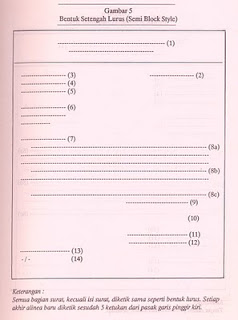
Description:
1.Kop Letter
2. Date of preparation of letters
3. Letter No.
4. attachment
5. case
6. The letter addressed
7. a word of salutation
8a. Introduction letter
8b. Explanation letter
8c. The cover letter
9. Greetings Closing
10. Name of office
11. signature
12. Names to approach
13. copy
14. Attachment page letter / initials

- Simplified-style
Simplified-style business letters contain all the same elements as
the full-block and semi-block letters. Like the full-block format, the
simplified format left-justifies every line except for the company logo or
letterhead. The date line is either slightly right of center or flush with the
center of the page. Letters written in the simplified format have fewer
internal sections, such as the body, salutation and date line.
Using the simplified style is the most useful at times when you
don’t have a recipient’s contact name. Because the simplified style does not
require a salutation, you don’t need the person’s name. The simplified format
does away with unneeded formality while maintaining a professional approach.

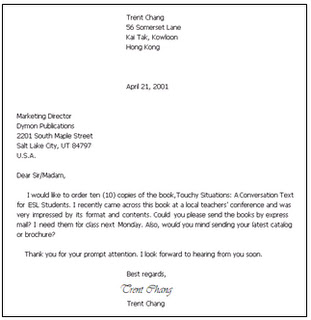
- Hanging-Indented
Style
This very useful style places the first words of each paragraph
prominently on the page. It is useful for letters that deal with a variety of
different topics. However, for normal business communications, this style is
very rarely used. The first line of the paragraph begins at the left-hand
margin. And the other lines of the same paragraph are indented three to four
spaces. This is the reversal of semi-indented style discussed in other page.
4. Kinds
of Business Letter
Sales Letters
Typical sales letters start off with a very strong statement to
capture the interest of the reader. Since the purpose is to get the reader to
do something, these letters include strong calls to action, detail the benefit
to the reader of taking the action and include information to help the reader
to act, such as including a telephone number or website link.
Order Letters
Order letters are sent by consumers or businesses to a
manufacturer, retailer or wholesaler to order goods or services. These letters
must contain specific information such as model number, name of the product,
the quantity desired and expected price. Payment is sometimes included with the
letter.
Complaint Letters
The words and tone you choose to use in a letter complaining to a
business may be the deciding factor on whether your complaint is satisfied. Be
direct but tactful and always use a professional tone if you want the company
to listen to you.
Adjustment Letters
An adjustment letter is normally sent in response to a claim or
complaint. If the adjustment is in the customer’s favor, begin the letter with
that news. If not, keep your tone factual and let the customer know that you
understand the complaint.
Inquiry Letters
Inquiry letters ask a question or elicit information from the recipient.
When composing this type of letter, keep it clear and succinct and list exactly
what information you need. Be sure to include your contact information so that
it is easy for the reader to respond.
Follow-Up Letter
Follow-up letters are usually sent after some type of initial
communication. This could be a sales department thanking a customer for an
order, a businessman reviewing the outcome of a meeting or a job seeker
inquiring about the status of his application. In many cases, these letters are
a combination thank-you note and sales letter.
Letters of Recommendation
Prospective employers often ask job applicants for letters of
recommendation before they hire them. This type of letter is usually from a
previous employer or professor, and it describes the sender’s relationship with
and opinion of the job seeker.
Acknowledgment Letters
Acknowledgment letters act as simple receipts. Businesses send
them to let others know that they have received a prior communication, but
action may or may not have taken place.
Cover Letter
Cover letters usually accompany a package, report or other
merchandise. They are used to describe what is enclosed, why it is being sent
and what the recipient should do with it, if there is any action that needs to
be taken. These types of letters are generally very short and succinct.
Letters of Resignation
When an employee plans to leave his job, a letter of resignation
is usually sent to his immediate manager giving him notice and letting him know
when the last day of employment will be. In many cases, the employee also will
detail his reason for leaving the company.
Sumber :
http://www.effective-business-letters.com/Hanging-Indented-Style.html
http://yodi-adhari.blogspot.com/
http://smallbusiness.chron.com/simplified-style-business-letter-10318.html
http://yodi-adhari.blogspot.com/
http://smallbusiness.chron.com/simplified-style-business-letter-10318.html
Writing a professional, polished
business letter or business email is easy once you know the basics. Most
business letters are written in a simple format that is easily adapted to any
company’s needs, and business email follows a similarly simple format. Read on
to learn more about how to make your business correspondence look its best.
How to write
business letter : The basics
A business letter always contains a few standard parts:
·
The date
·
Information about its sender and recipient
·
A salutation
·
A body consisting of a few concise paragraphs
·
A closing
·
The sender’s signature
·
The sender’s typed name, title, and contact
information
·
A list of enclosures, if necessary
Company address:
If your company has letterhead, you can use this instead of typing out the
information. If not, your company’s address should appear either right or left
justified at the top of the page. Write out each word in the address instead of
using abbreviations. For example:
ABC, Inc.
400 Leafy Lane
Los Angeles, California 90002
400 Leafy Lane
Los Angeles, California 90002
Date:
Write the date out rather than abbreviating with numbers only. For example,
“March 1, 2015” or “1 March 2015.” The date should be left justified and should
be positioned two or three lines above the recipient’s address.
Recipient’s name and address:
Add the recipient’s name, their title if known, and their address. Write
out each word in the recipient’s address. This information should be left
justified a few lines above the salutation. For example:
Mr. Jack Reacher
Merchandising Manager
Craft Supply Provider, Inc.
602 Spinner’s Road
Los Angeles, California 90001
Merchandising Manager
Craft Supply Provider, Inc.
602 Spinner’s Road
Los Angeles, California 90001
Salutation:
Choose your salutation based on whether you know the person to whom you are
writing, how well you know them if so, and the relationship’s level of
formality. A salutation is more than a simple greeting; it is an indicator of
respect. There are several options to use depending on the situation:
·
To Whom It May Concern: Use this
generic greeting only if you don’t know whom you are specifically addressing.
·
Dear Sir / Madam: This is
another generic greeting that should only be used if you don’t know who will be
reading your letter.
·
Recipient’s Title and Last Name: This is
a widely accepted method of incorporating a salutation into business
correspondence. Examples include: “Dear Dr. Jamison” or “Dear Professor
Williams.” The salutations “Dear Mr. Smith,” “Dear Ms. Kennedy,” and “Dear Mrs.
Rollins” are additional examples of this kind of greeting.
·
Recipient’s First Name: Use this
only if you and the recipient already enjoy an informal relationship. An
example is: “Dear Maria.”
·
The Recipient’s Whole Name: If the
recipient does not have a title and you are unsure of their gender, you should
greet them using their entire name. For example: “Dear Pat Brown.”
Always add a comma after a salutation, unless you are using “To Whom It May
Concern,” in which case a colon is appropriate.
Body:
The body of your business letter should contain a few concise paragraphs
that convey your message clearly. Strike the right tone by avoiding lengthy,
meandering sentences and getting straight to the point. If you are not sure how
to start, consider using “I am writing you regarding…” as the opening phrase.
Your reader will get the best impression when your meaning is
crystal-clear. You should explain your position using as few words as possible
an. At the same time, feel free to be conversational if it is appropriate.
Business correspondence should be friendly and helpful if possible.
Summarize your points clearly in the last paragraph and outline your
expectations or your planned course of action. This is a suitable place to
mention that the recipient may contact you with concerns or questions. Be sure
to thank the recipient for his or her attention to the letter or to the matter
at hand.
Closing:
Like its salutation, a business letter’s closing is an indicator of respect
that should reflect the formality of your relationship.
·
Formal Closing: A
closing such as “Sincerely,” “Yours sincerely,” “Respectfully,” “Yours Truly,”
“Regards,” and “Cordially” are suitable for all types of business
correspondence.
·
Informal Closing: Less
formal closings such as “Best wishes,” “Warm regards,” “Best,” “Thank you,” and
“All the best” are still professional, but are best for letters to people with
whom you enjoy an ongoing, friendly business relationship.
Use a comma after your closing, no matter which you choose. Left justify
the closing.
Signature:
Leave about four lines of text empty so you have room to sign your name.
Use blue or black ink for a clean, professional look.
Sender’s typed name and contact
information:
Type your name, then add your title on the next line. Skip a line, then
type your telephone number. On the next line, type your email address. For
example:
Terry Brown
Vice President of ABC, Inc.
223-555-1212
t.brown@abc-inc.com
This information should be left justified.
Vice President of ABC, Inc.
223-555-1212
t.brown@abc-inc.com
This information should be left justified.
Enclosures (if applicable):
If you plan to enclose anything with your business letter, type the word
“Enclosures” followed by a colon and make a note that tells the recipient what
else to look for in the envelope. For example:
Enclosures (2): brochure, flyer
Enclosures: two brochures
Enclosures: two brochures
2. Part of Business Letter
The Heading (The Retern Address) or
Letterhead - Companies usually use printed paper where heading or
letterhead is specially designed at the top of the sheet. It bears all the
necessary information about the organisation’s identity.
Date - Date of writing. The month
should be fully spelled out and the year written with all four digits October
12, 2005
(12 October 2005 - UK style). The date is aligned with the return address. The number of the date is pronounced as an ordinal figure, though the endings st, nd, rd,th, are often omitted in writing. The article before the number of the day is pronounced but not written. In the body of the letter, however, the article is written when the name of the month is not mentioned with the day.
(12 October 2005 - UK style). The date is aligned with the return address. The number of the date is pronounced as an ordinal figure, though the endings st, nd, rd,th, are often omitted in writing. The article before the number of the day is pronounced but not written. In the body of the letter, however, the article is written when the name of the month is not mentioned with the day.
The Inside Address - In a
business or formal letter you should give the address of the recipient after
your own address. Include the recipient's name, company, address and postal
code. Add job title if appropriate. Separate the recipient's name and title
with a comma. Double check that you have the correct spelling of the recipient
's name.
The Inside Address is always on the left margin. If an 8 1/2" x 11" paper is folded in thirds to fit in a standard 9" business envelope, the inside address can appear through the window in the envelope.
The Inside Address is always on the left margin. If an 8 1/2" x 11" paper is folded in thirds to fit in a standard 9" business envelope, the inside address can appear through the window in the envelope.
The Greeting - Also called the
salutation. The type of salutation depends on your relationship with the
recipient. It normally begins with the word "Dear" and always
includes the person's last name. Use every resource possible to address
your letter to an actual person. If you do not know the name or the
sex of of your reciever address it to Dear Madam/Sir (or Dear Sales Manager or
Dear Human Resources Director). As a general rule the greeting in a
business letter ends in a colon (US style). It is also acceptable to use a
comma (UK style).
The Subject Line (optional) - Its
inclusion can help the recipient in dealing successfully with the aims of your
letter. Normally the subject sentence is preceded with the word Subject: or Re: Subject
line may be emphasized by underlining, using bold font, or all captial letters.
It is usually placed one line below the greeting but alternatively can be
located directly after the "inside address," before the
"greeting."
The Body Paragraphs - The body is
where you explain why you’re writing. It’s the main part of the business
letter. Make sure the receiver knows who you are and why you are writing but
try to avoid starting with "I". Use a new paragraph when you wish to
introduce a new idea or element into your letter. Depending on the letter style
you choose, paragraphs may be indented. Regardless of format, skip a line
between paragraphs.
The Complimentary Close - This
short, polite closing ends always with a comma. It is either at the left margin
or its left edge is in the center, depending on the Business Letter Style that
you use. It begins at the same column the heading does. The traditional
rule of etiquette in Britain is that a formal letter starting "Dear Sir or
Madam" must end "Yours faithfully", while a letter starting
"Dear " must end "Yours sincerely". (Note: the
second word of the closing is NOT capitalized)
Signature and Writer’s identification -
The signature is the last part of the letter. You should sign your first and
last names. The signature line may include a second line for a title, if
appropriate. The signature should start directly above the first letter of the
signature line in the space between the close and the signature line. Use blue
or black ink.
Initials, Enclosures, Copies -
Initials are to be included if someone other than the writer types the letter.
If you include other material in the letter, put 'Enclosure', 'Enc.', or '
Encs. ', as appropriate, two lines below the last entry. cc means a copy or
copies are sent to someone else.
3. Style Of Business Letter
Business letter can be written with different styles, such as:
- Full
Block.
Full block style is a letter format in which all text is justified
to the left margin. In block letter style, standard punctuation is placed after
salutations and in other headings. Open punctuation, however, refers to a
modification of style where all nonessential punctuation is omitted. A few key
factors will help you understand block style format and the difference that
open punctuation makes.
1. Return Address: If your
stationery has a letterhead, skip this. Otherwise, type your name, address and
optionally, phone number. These days, it’s common to also include an email
address. 2. Date: Type the date of your letter two to six
lines below the letterhead. Three are standard. If there is no letterhead, type
it where shown.
3. Reference Line: If the recipient specifically requests
information, such as a job reference or invoice number, type it on one or two
lines, immediately below the Date.
4. Special Mailing Notations: Type
in all uppercase characters, if appropriate.
5. On-Arrival Notations: Type in all uppercase
characters, if appropriate. You might want to include a notation on private
correspondence.
6. Inside Address: Type the name and address of
the person and/or company to whom you’re sending the letter, three to eight
lines below the last component you typed. Four lines are standard.
7. Attention Line: Type the name of the person to
whom you’re sending the letter.
8. Salutation: Type the recipient’s name here. Type
Mr. or Ms. [Last Name] to show respect, but don’t guess spelling or gender.
9. Subject Line: Type the gist of your letter in
all uppercase characters, either flush left or centered. Be concise on one
line.
10. Body: Type two spaces between sentences. Keep
it brief and to the point.
11. Complimentary Close: What you type here depends on
the tone and degree of formality.
12. Signature Block: Leave four blank lines after the
Complimentary Close to sign your name. Sign your name exactly as you type it
below your signature. Title is optional depending on relevancy and degree of
formality.
13. Identification Initials: If someone
typed the letter for you, he or she would typically include three of your
initials in all uppercase characters, then two of his or hers in all lowercase
characters.
14. Enclosure Notation: This line tells the reader to
look in the envelope for more. Type the singular for only one enclosure, plural
for more.
15. cc: Stands for courtesy copies (formerly
carbon copies). List the names of people to whom you distribute copies, in
alphabetical order.
- Semi-block
style
Semi-blok fromat: in a format this text parallel left and all
paragraphs in the letter is indented. Format shape on this letter on letter
head, date, complementary a close, and signature being in a position flattened
right. In the layout uneven right, but can dibilangg flattened middle. Other
parts on a letter as inside address, subject, salutation, body of letter, and
enclosure if terdapatnya attachment letter,Being flattened on the left.
Sample Form Letter Semi Block Style :
Description:
1.Kop Letter
2. Date of preparation of letters
3. Letter No.
4. attachment
5. case
6. The letter addressed
7. a word of salutation
8a. Introduction letter
8b. Explanation letter
8c. The cover letter
9. Greetings Closing
10. Name of office
11. signature
12. Names to approach
13. copy
14. Attachment page letter / initials
- Simplified-style
Simplified-style business letters contain all the same elements as
the full-block and semi-block letters. Like the full-block format, the
simplified format left-justifies every line except for the company logo or
letterhead. The date line is either slightly right of center or flush with the
center of the page. Letters written in the simplified format have fewer
internal sections, such as the body, salutation and date line.
Using the simplified style is the most useful at times when you
don’t have a recipient’s contact name. Because the simplified style does not
require a salutation, you don’t need the person’s name. The simplified format
does away with unneeded formality while maintaining a professional approach.
- Hanging-Indented
Style
This very useful style places the first words of each paragraph
prominently on the page. It is useful for letters that deal with a variety of
different topics. However, for normal business communications, this style is
very rarely used. The first line of the paragraph begins at the left-hand
margin. And the other lines of the same paragraph are indented three to four
spaces. This is the reversal of semi-indented style discussed in other page.
4. Kinds
of Business Letter
Sales Letters
Typical sales letters start off with a very strong statement to
capture the interest of the reader. Since the purpose is to get the reader to
do something, these letters include strong calls to action, detail the benefit
to the reader of taking the action and include information to help the reader
to act, such as including a telephone number or website link.
Order Letters
Order letters are sent by consumers or businesses to a
manufacturer, retailer or wholesaler to order goods or services. These letters
must contain specific information such as model number, name of the product,
the quantity desired and expected price. Payment is sometimes included with the
letter.
Complaint Letters
The words and tone you choose to use in a letter complaining to a
business may be the deciding factor on whether your complaint is satisfied. Be
direct but tactful and always use a professional tone if you want the company
to listen to you.
Adjustment Letters
An adjustment letter is normally sent in response to a claim or
complaint. If the adjustment is in the customer’s favor, begin the letter with
that news. If not, keep your tone factual and let the customer know that you
understand the complaint.
Inquiry Letters
Inquiry letters ask a question or elicit information from the recipient.
When composing this type of letter, keep it clear and succinct and list exactly
what information you need. Be sure to include your contact information so that
it is easy for the reader to respond.
Follow-Up Letter
Follow-up letters are usually sent after some type of initial
communication. This could be a sales department thanking a customer for an
order, a businessman reviewing the outcome of a meeting or a job seeker
inquiring about the status of his application. In many cases, these letters are
a combination thank-you note and sales letter.
Letters of Recommendation
Prospective employers often ask job applicants for letters of
recommendation before they hire them. This type of letter is usually from a
previous employer or professor, and it describes the sender’s relationship with
and opinion of the job seeker.
Acknowledgment Letters
Acknowledgment letters act as simple receipts. Businesses send
them to let others know that they have received a prior communication, but
action may or may not have taken place.
Cover Letter
Cover letters usually accompany a package, report or other
merchandise. They are used to describe what is enclosed, why it is being sent
and what the recipient should do with it, if there is any action that needs to
be taken. These types of letters are generally very short and succinct.
Letters of Resignation
When an employee plans to leave his job, a letter of resignation
is usually sent to his immediate manager giving him notice and letting him know
when the last day of employment will be. In many cases, the employee also will
detail his reason for leaving the company.
Sumber :
http://www.effective-business-letters.com/Hanging-Indented-Style.html
http://yodi-adhari.blogspot.com/
http://smallbusiness.chron.com/simplified-style-business-letter-10318.html
http://yodi-adhari.blogspot.com/
http://smallbusiness.chron.com/simplified-style-business-letter-10318.html

Tidak ada komentar:
Posting Komentar